The Safari Accommodation Gallery Reviews Field Reports Downloads Book Now

Best Place to See Wild Orangutans in Borneo

Why Deramakot is Sabah's most reliable place for a wild, eye-level orangutan sighting — the forest road, the salt-lick research, and the population data behind it.

Photo: Mike Gordon, wildlifeofborneo.com
~900
Orangutans within
Deramakot itself (SFD nest count)
5,933
Deramakot + Ulu Segama
combined landscape, 2017
~11,000
Sabah-wide orangutan
population, statewide survey
1997
Year Deramakot was
first FSC certified

Every operator in Sabah will tell you their patch is good for orangutan. Most of that is marketing recycled from the same few brochures, decades old and rarely checked against the primary research. This is our version, built from the surveys, the published field studies, and a great many mornings and afternoons on Deramakot's forest roads.

A working forest, not a park

Deramakot is a commercial timber concession, not a protected sanctuary, and that distinction matters more than it sounds. Logging in the reserve stopped in 1989 to make way for a joint project between the Sabah Forestry Department and the German technical agency GTZ, aimed at proving that a natural forest could be logged and still function as intact habitat. A ten-year Forest Management Plan took effect in 1995, and in July 1997 Deramakot became the first natural tropical forest reserve in Southeast Asia certified "well managed" under the Forest Stewardship Council — a certification the reserve has now held continuously for close to three decades.

Around 51,000 of the reserve's roughly 55,000 hectares are zoned for reduced impact logging (RIL): selective, low-volume harvesting on long cycles, with skid trails, riparian buffers and mineral licks mapped and avoided before a single tree is felled. The remainder is set aside as strict conservation zone. Sabah Forestry Department officers who helped build the RIL system, including District Forest Officer Peter Lagan, later co-authored a paper for a 2003 Workshop on Orangutan Conservation in Sabah making the case explicitly: a well-managed logging concession, done this way, can hold as much orangutan habitat value as land under formal protection.

That's the part visitors don't expect. The apes here share a working landscape with a forestry operation, and the daily presence of an unarmed, non-hunting workforce — rather than an empty, unpatrolled forest — appears to be part of why the wildlife tolerates vehicles as well as it does.

The road that puts you at eye level

Most wild orangutan encounters in Borneo happen looking up — a shape shifting through canopy thirty or forty metres overhead, backlit, more silhouette than sighting. Deramakot's terrain works against that. A long stretch of the main access road is cut into the side of a ridge rather than run through the valley floor, so vehicle and canopy end up on roughly the same plane. An orangutan feeding in a mid-storey fig or moving along a lateral branch is often at, or very close to, eye level rather than neck-craning height — close enough to watch the hand-over-hand grip, the way it tests a branch before committing weight, without binoculars doing the work.

It's a quirk of road engineering and topography more than anything mystical, but it's the single biggest reason a Deramakot sighting tends to be remembered differently from a river cruise or a canopy walkway view: less "there's one, up there," more watching an animal simply get on with its day at a distance you can actually read.

Field note

Morning drives are good, but afternoons are usually better. The light sits behind you rather than behind the animal, which makes a real difference to what you actually see and photograph, and every afternoon orangutans start climbing higher into the canopy to build the night's nest — activity that puts them in motion and often in the open, rather than resting still and half-hidden as they tend to be at midday. Night drives target a different cast entirely (civets, cats, owls) and aren't the time to expect orangutan.

More time on the road simply means more chances. Most guests booking with orangutans specifically in mind join our 3-night Deramakot Discovery Safari or our 4-night Intensive Mammal Safari, which gives enough drives for the odds to work in your favour.
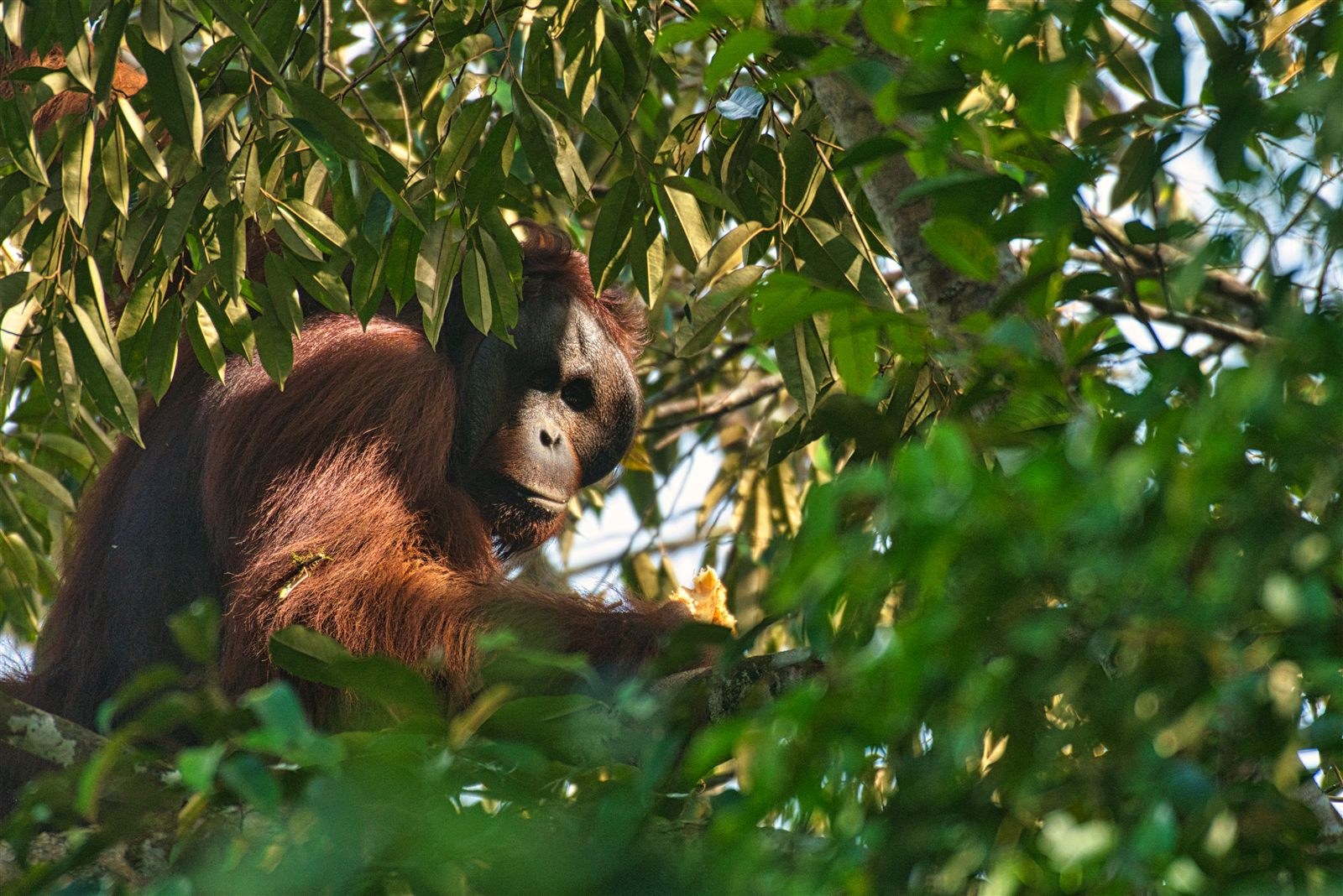
A wild orangutan feeding on durian at close to eye level beside a Deramakot forest road
Deramakot's ridge-cut roads put vehicle and canopy on roughly the same plane — a rare thing in Borneo.Photo: Mike Gordon, wildlifeofborneo.com

How many orangutans, really

Numbers get thrown around loosely in Borneo tourism copy — a single figure, "half of Sabah's population," recycled across dozens of sites without anyone tracing it back to a source. Here's what the actual surveys say about the Bornean orangutan (Pongo pygmaeus), and — since it's the number that actually matters if you're coming here — what's specific to Deramakot itself, as opposed to the wider landscape it's usually quoted alongside.

For Deramakot on its own, the clearest figure is the Sabah Forestry Department's own biennial aerial nest count, carried out inside the reserve's 55,000 hectares: a minimum estimate of around 900 orangutans within Deramakot itself.

A 2002–03 state-wide aerial and ground survey led by Marc Ancrenaz, published in PLOS Biology, put Sabah's total wild orangutan population at around 11,000 individuals, and identified the forest block that then included Deramakot ("population 15," the northern side of the upper Kinabatangan) as holding roughly 1,700 apes at the time. Fifteen years later, WWF-Malaysia's Donna Simon led a repeat helicopter survey of the same populations, published in 2019 in PLOS ONE, putting the figure at 5,933 by 2017. That number gets quoted often as "Deramakot's population," but it isn't one — the survey flew Deramakot and the adjoining Ulu Segama forest reserve together as a single combined landscape, because that's the natural forest block on the ground, not because it's a fair stand-in for Deramakot on its own.

The study's authors point to the absence of hunting inside the managed reserve as a major factor in that landscape's stability — a fairly direct rebuttal to the assumption that a working timber concession can't also be a conservation stronghold.

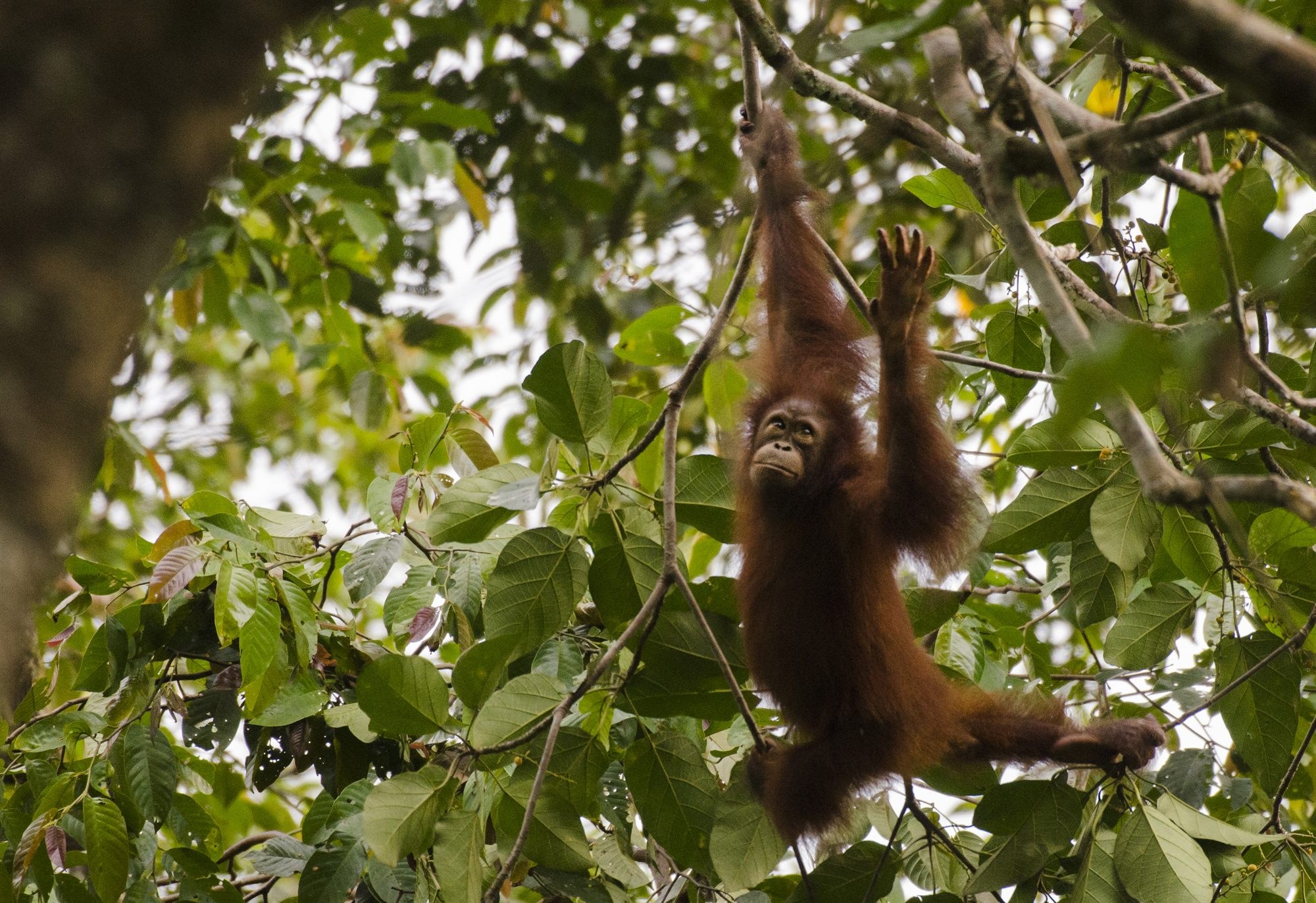
A wild orangutan swinging through the canopy in Deramakot Forest Reserve
One of the roughly 900 orangutans within Deramakot itself, moving through the canopy.Photo: Mike Gordon, wildlifeofborneo.com

Orangutan twins — an exceptionally rare sighting

Wild orangutan twins are one of the rarest things a camera can catch in this forest, or anywhere the species occurs. A single infant every six to eight years is the norm; the first ever documented sighting of wild orangutan twins anywhere was only recorded in Borneo in 2007, and most twin births that have been observed since, in the wild or in captivity, have seen only one infant survive. A confirmed pair, both alive and travelling with their mother, is a genuine rarity.

Sightings like this are exactly why longer stays pay off — footage this rare tends to come from guests on our 4-night safari, not a quick overnight stop.

Orangutan twins filmed in Deramakot Forest Reserve — twin births are exceptionally rare in wild orangutans, with the first documented sighting anywhere only recorded in 2007.

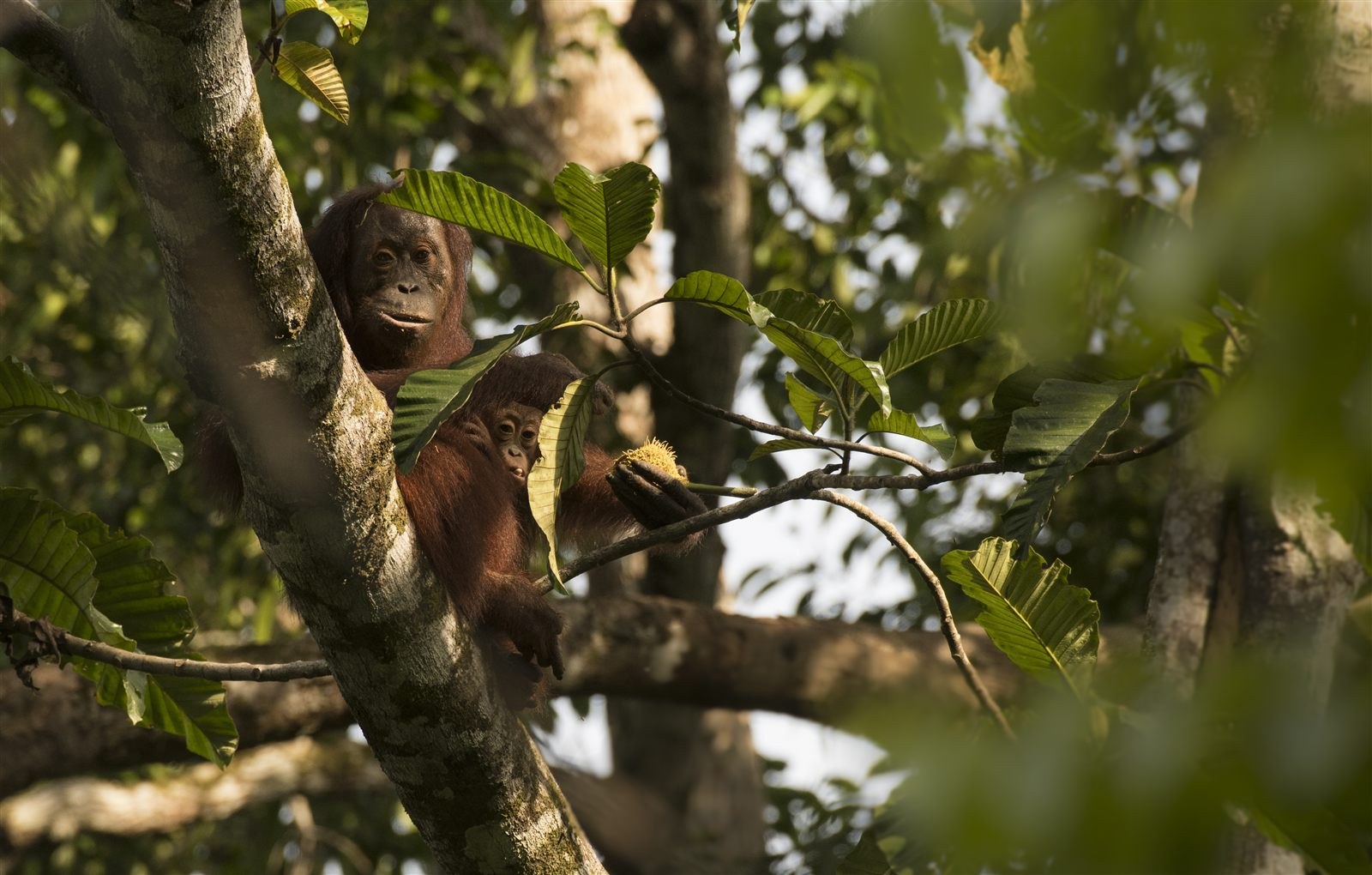
An orangutan mother with her infant, photographed in Deramakot Forest Reserve
A mother and infant in Deramakot — single infants every six to eight years is the norm for the species, which is what makes a confirmed pair of twins so rare.Photo: Mike Gordon, wildlifeofborneo.com

What the salt licks tell us

Some of the most detailed ground-level research on Deramakot's orangutans comes not from the canopy but from its natural mineral licks — patches of exposed, mineral-rich soil where wildlife comes to eat earth, supplementing a diet that's otherwise short on sodium and other trace minerals. Sabah Forestry Department officer Peter Lagan, working with wildlife biologist Hisashi Matsubayashi, documented these sites in detail in Natural Salt-Licks and Mammals in Deramakot (2014), a Sabah Forestry Department publication that makes the case for protecting licks as biodiversity hotspots in their own right.

An earlier camera-trap study by the same research team, published in the Raffles Bulletin of Zoology, ran cameras at Deramakot's licks for a full year and found orangutans among the top three species recorded at every site. Visitation broke down by class: flanged adult males accounted for 31% of visits, females travelling with an infant 17%, and all other classes (unflanged males, solitary females, sub-adults) the remaining 52% — evidence that licks matter to the whole population, not just to territorial males passing through. The same study found lick use was shaped more by disturbance from nearby human activity than by the mineral content of the soil itself, which is part of why the reserve's protected licks are treated as sensitive sites and why guides tend to know precisely where they are and how to approach them quietly.

A related survey of Deramakot's licks found orangutans among the five most frequently recorded species overall, alongside sambar deer, bearded pig, lesser mouse-deer and Malay badger — together accounting for the large majority of all animal visits captured on camera across a full year.

"Natural-licks use by orangutans was impacted more by human activity than concentration of the minerals... these results suggest that the natural-licks are key habitats for all classes of orangutans and suitable sites for ground monitoring." Matsubayashi et al., Raffles Bulletin of Zoology 59(1), 2011

Practically, this is part of what makes a Deramakot sighting different from a purely arboreal one elsewhere: guides who know the lick network can sometimes bring guests close to genuinely ground-level activity, not just movement in the canopy.

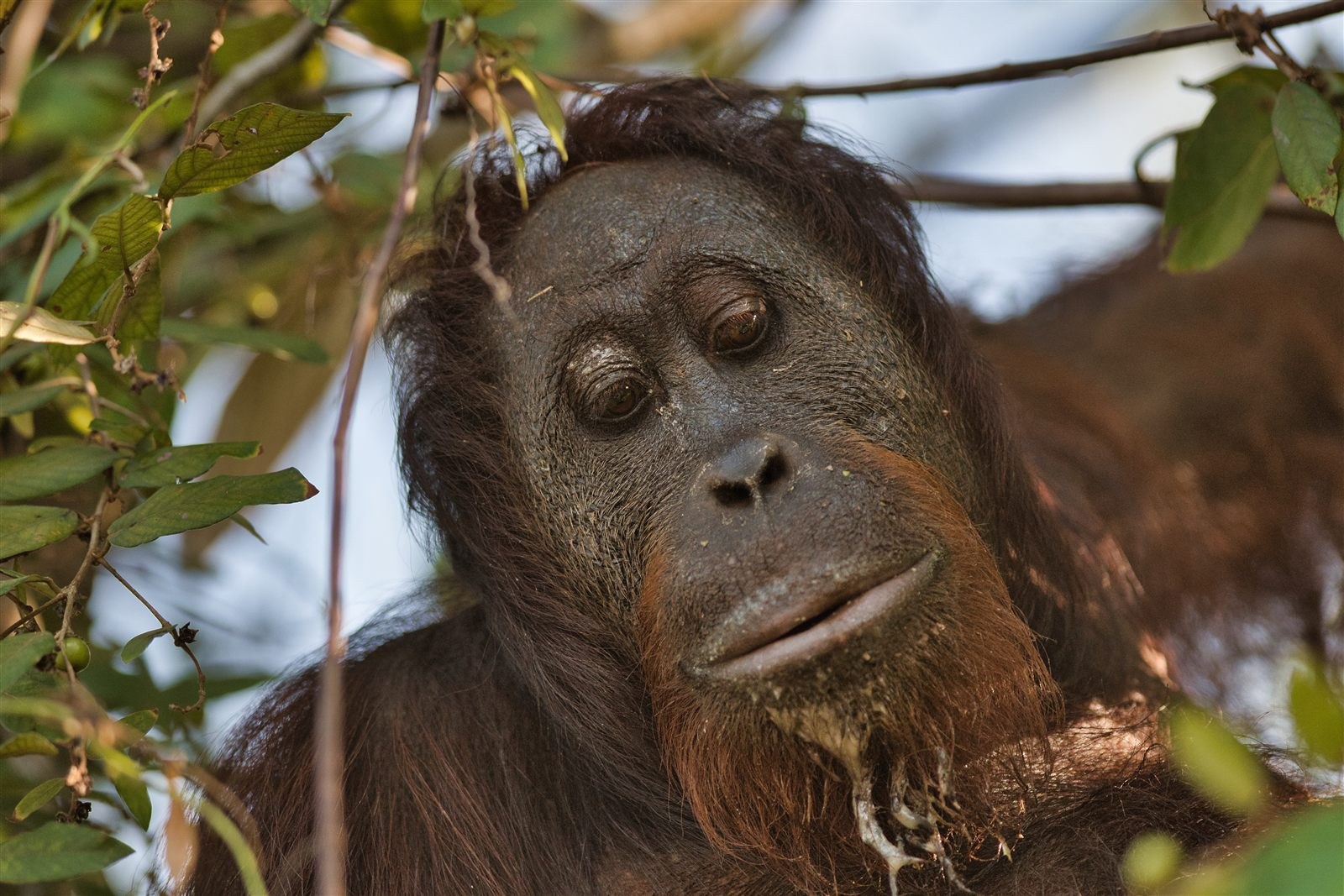
A wild orangutan in Deramakot Forest Reserve, one of the species most frequently recorded at the reserve's natural salt licks
Orangutans are consistently among the top species recorded at Deramakot's natural salt licks, across every class from flanged males to females with infants.Photo: Mike Gordon, wildlifeofborneo.com

Gomantong Caves — the other reliable option

Gomantong is usually sold purely for its bats and swiftlets — millions of them, harvested for birds' nest under a centuries-old tradition, pouring out at dusk to a waiting crowd of bat hawks. What gets less attention is the forest around the cave itself. Gomantong Hill sits inside a substantial block of protected primary and logged rainforest in the Lower Kinabatangan, and the short boardwalk trail to the cave entrance runs directly through it. Wild orangutans, along with langurs and a strong resident bird list, are seen regularly enough along that walk that several lodges in the area run a dedicated afternoon "orangutan and langur" excursion built around exactly this stretch of forest, timed to finish with the bat exodus.

As with any wild, unhabituated sighting, nobody honest will promise you one — the operators who run this walk are upfront that it comes down to persistence and a bit of luck on the day. But Gomantong sits close enough to Sandakan and the Kinabatangan River to slot naturally into most Deramakot or Kinabatangan itineraries as a genuine second shot at a sighting, not just a bat-cave detour.

For the wider picture on Deramakot itself, see our complete guide to Deramakot Forest Reserve, or browse our field reports for first-hand sighting accounts. Ready to book? Our 3-night and 4-night Deramakot safaris are the two most popular starting points.

Sources & further reading

  1. Ancrenaz, M. et al. (2004). Aerial Surveys Give New Estimates for Orangutans in Sabah, Malaysia. PLOS Biology 3(1):e3
  2. Simon, D., Davies, G. & Ancrenaz, M. (2019). Changes to Sabah's orangutan population in recent times: 2002–2017. PLOS ONE 14(7):e0218819
  3. Matsubayashi, H. & Lagan, P. (2014). Natural Salt-Licks and Mammals in Deramakot: Their Importance and Why They Should Be Conserved. Sabah Forestry Department, iv + 60pp.
  4. Matsubayashi, H., Ahmad, A. H., Wakamatsu, N. et al. (2011). Natural-licks use by orangutans and conservation of their habitats in Bornean tropical production forest. Raffles Bulletin of Zoology 59(1): 109–115
  5. Lagan, P., Mannan, S. & Matsubayashi, H. (2007). Sustainable use of tropical forests by reduced-impact logging in Deramakot Forest Reserve, Sabah, Malaysia. Ecological Research
  6. Mannan, S., Awang, Y., Radin, A., Abi, A., Suparlan, S. H. & Lagan, P. (2003). Conservation of the Orangutan and Forest Management Units: The Deramakot Model. Paper presented at the Workshop on Orangutan Conservation in Sabah, Sabah Forestry Department
  7. mammalwatching.com — Deramakot trip reports, founded and edited by Jon Hall. Independent field reports, ongoing
  8. Bornean orangutan (Pongo pygmaeus) — IUCN Red List assessment. Critically Endangered
  9. Bornean Orangutan species profile — WildlifeOfBorneo.com. Photography and species notes, Mike Gordon

Plan an orangutan-focused Deramakot trip

Tell us your travel dates, group size and target species, and we'll come back with availability and what the trip would look like.

See Safari Packages Enquire Now