The Safari Accommodation Gallery Reviews Field Reports Downloads Book Now

Deramakot Forest Reserve

A working timber concession that became one of the finest places in Borneo to watch wild mammals.

55,507
Hectares of
lowland forest
1997
First FSC certified —
the world's longest
~900
Orangutans
(minimum estimate)
5
Wild cat species
recorded

The world's longest-certified tropical rainforest — and how a working logging concession became one of the finest places in Borneo to watch wild mammals.

Deramakot Forest Reserve covers 55,507 hectares of lowland dipterocarp forest in the interior of Sabah, Malaysian Borneo. It is not a national park. It is a commercial forest reserve — a working timber concession that is still being logged today.

That contradiction is the whole story. Deramakot produces timber and holds one of the densest populations of rare mammals in Southeast Asia at the same time. Understanding why is the difference between seeing Deramakot as just another stop on a Borneo itinerary and understanding why serious wildlife watchers travel across the world for it.

A forest that was written off

By the late 1980s Deramakot had been conventionally logged and was, in the language of the day, a degraded logged-over area. Conventional tropical logging of that era was extractive in the crudest sense: heavy machinery, unplanned skid trails, canopy damage far beyond the trees actually harvested, and no meaningful plan for what the forest would look like in fifty years.

In 1989 the Sabah Forestry Department began a collaboration with GTZ, the German agency for technical cooperation, to test whether a logged-over commercial reserve could be managed sustainably instead of being written off or converted to plantation. Deramakot became the testing ground.

The approach that emerged is known as Reduced Impact Logging (RIL). In practice it means:

The stated aim was to mimic natural forest processes to produce low-volume, high-quality, high-value timber indefinitely, rather than extracting everything once.

1997: the first well-managed tropical forest

In 1997, Deramakot Forest Reserve was certified by the Forest Stewardship Council. It was the first natural forest in Southeast Asia to be managed under certified sustainable forestry principles, and it remains the longest-certified tropical rainforest in the world.

Certification timeline

The certification has not been continuous. Deramakot's original certificate was terminated on 30 October 2019, a casualty of the COVID-19 pandemic and the subsequent delay in appointing a new certification body. The reserve was reassessed and regained FSC certification in 2024, this time under Preferred by Nature. The current certificate — PBN-FM/COC-024465, licence code FSC-C180387, covering 55,507 hectares — runs until 20 March 2029.

The gap does not diminish the achievement. Deramakot has been managed to the same standard throughout; what lapsed was the paperwork, not the forestry.

The people behind it

Sustainable forest management in Sabah did not happen by accident, and it is worth naming the people who drove it.

Datuk Sam Mannan joined the Sabah Forestry Department in 1980 and served as Director of Forestry from 2004. He was an early and forceful advocate for reduced-impact logging at a time when the prevailing view held that a logged-over tropical reserve was spent ground, fit only for conversion. The argument he made — that a working commercial forest could be managed to a certified standard indefinitely, and that doing so was better business as well as better conservation — was not the consensus position when he made it. The FSC certification of Deramakot, the first tropical forest in Sabah to achieve it, is among the achievements most associated with his tenure, alongside a broad expansion of protected and certified forest across the state.

Peter Lagan of the Sabah Forestry Department co-authored the key technical work on Deramakot, including published research on reduced-impact logging and on Orangutan conservation within the reserve. The peer-reviewed literature documenting how RIL actually performs at Deramakot carries his name.
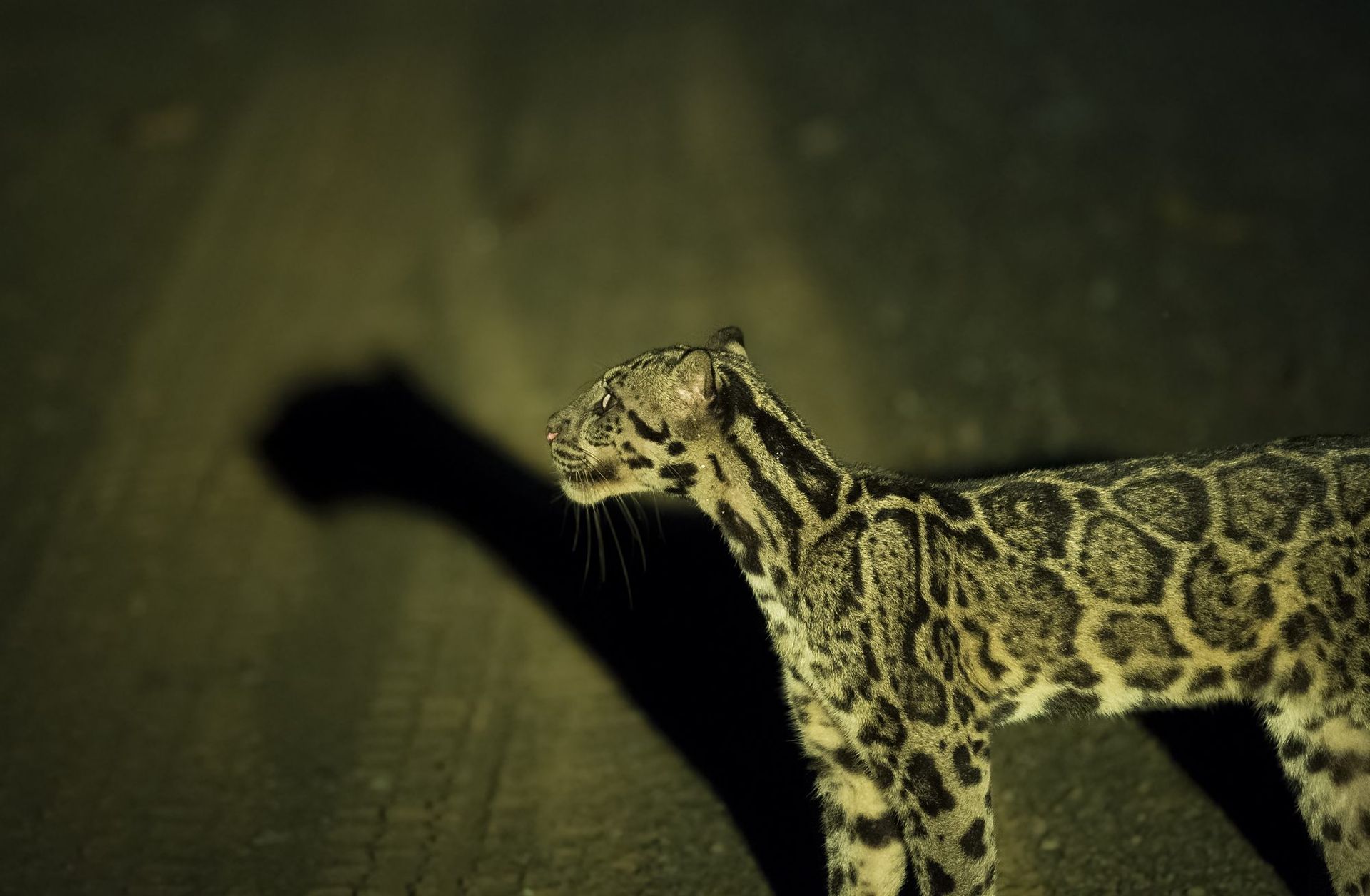
A female Sunda Clouded Leopard photographed in Deramakot Forest Reserve
Sunda Clouded Leopard — the subject of more than fifteen years of continuous camera-trap research at Deramakot.

The science that comes out of Deramakot

Because Deramakot is a managed reserve with decades of consistent records, it has become one of the most intensively studied tropical forests in Borneo. This is not a marketing claim — it is a bibliography.

Leibniz Institute for Zoo and Wildlife Research (Leibniz-IZW), Berlin

Working with the Sabah Forestry Department, Leibniz-IZW has run camera-trap research at Deramakot for well over a decade. In 2026 a study led by Leibniz-IZW and published in Biotropica documented the oldest wild Sunda Clouded Leopard ever recorded — a female estimated at around eight and a half years old. The study pooled 13 separate camera-trap surveys run between 2007 and 2023 across Deramakot, Tangkulap-Pinangah and Northern Kuamut: 15.5 years of data, 52 individual adult Clouded Leopards identified (30 males, 22 females), from 437 independent photo-captures.

Panthera

The global wild cat conservation organisation is a partner on this Clouded Leopard work, alongside the Sabah Forestry Department, the Sabah Wildlife Department and indigenous communities in Sabah.

Kyoto University

Japanese researchers, including work by Hiromitsu Samejima published through Kyoto University's Center for Southeast Asian Studies, developed and ran a Random Camera Trapping System across Deramakot and neighbouring Tangkulap — 827 km² surveyed between 2007 and 2010 — to compare mammal distribution between a certified, sustainably managed reserve and a conventionally logged one. Deramakot's value as a scientific control is precisely that there is a differently-managed forest next door.

Sabah Forestry Department

The department runs an Orangutan aerial nest count every two years as a standing monitoring component. Current estimates put a minimum of around 900 Orangutans inside Deramakot.

The findings have changed how these animals are understood. Clouded Leopards proved far more mobile than assumed, with individuals moving up to 36 kilometres between forest reserves. Females turned out to be roughly 68% harder to detect than males — they spend far more time in the canopy, where their lighter build and heavier tail help them balance.

The reserve is recognised as key habitat for five globally threatened large mammals: Orangutan, Bornean Pygmy Elephant, Tembadau (Banteng), Proboscis Monkey and Sunda Clouded Leopard.

Why the wildlife is so visible here

Visitors often assume Deramakot's mammal sightings are down to sheer abundance. Abundance matters, but it is not the mechanism.

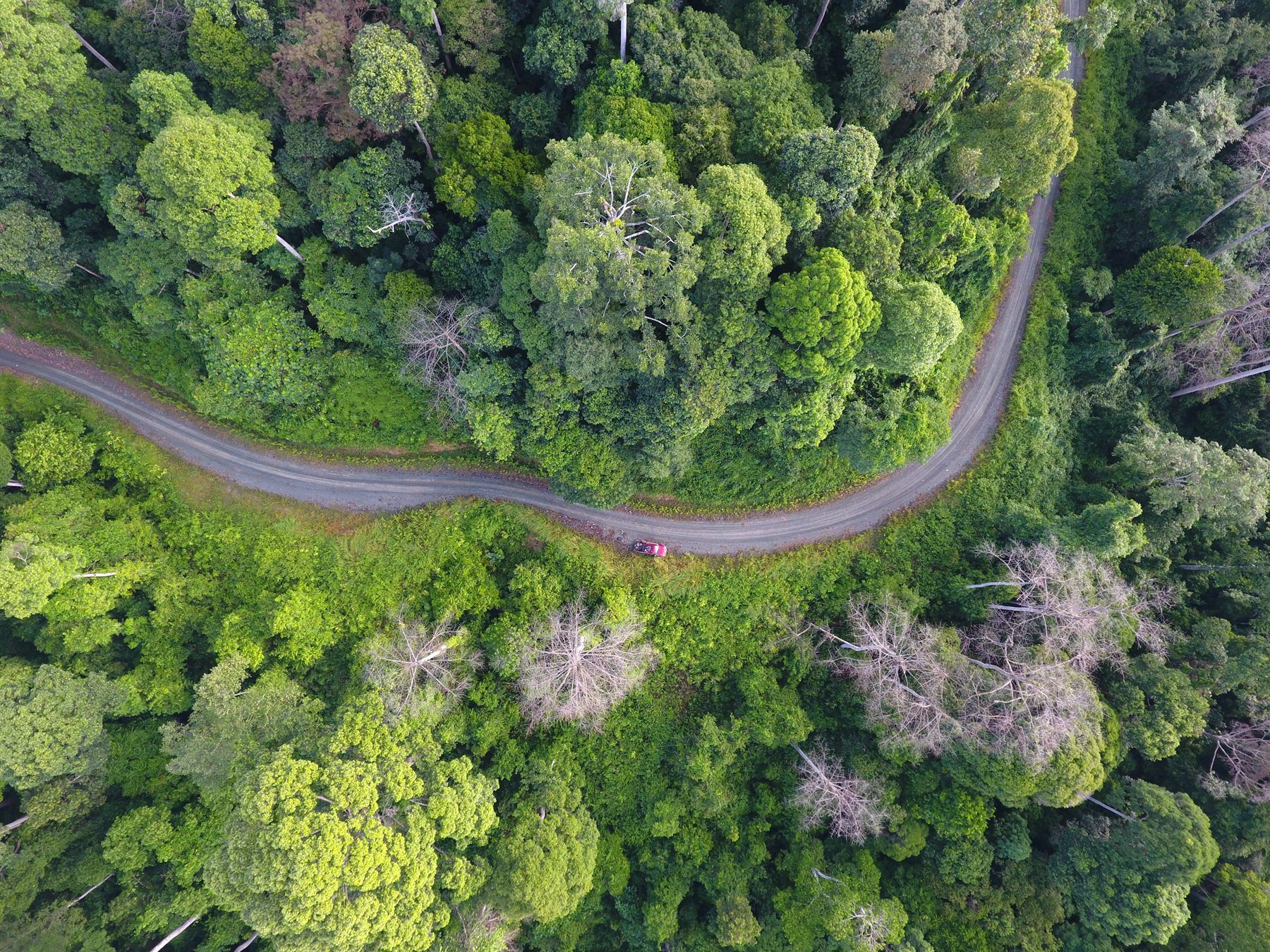
The mechanism is the road network. Decades of planned, low-impact forestry left Deramakot with a lattice of well-maintained gravel roads running through continuous, structurally intact forest. Those roads do three things at once:

In a national park, roads are a compromise. At Deramakot, the road network is the legacy of the forestry operation — and it happens to be one of the best pieces of mammal-watching infrastructure in Borneo.

Aerial view of a forestry road running through continuous forest at Deramakot
The legacy of decades of planned, low-impact forestry: gravel roads through structurally intact forest.

How Deramakot changed wildlife tourism in Borneo

For most of Borneo's tourism history, the night drive was an afterthought — a short bolt-on at the end of a day built around Orangutans, Proboscis Monkeys and river cruises. Deramakot changed that. Here the night drive is treated as a serious activity in its own right, planned for and built around rather than tacked on.

That did not arrive fully formed. A small number of operators worked the reserve in the early years, before it had a reputation to trade on — learning which junctions the cats favoured, which trees held fruiting figs, and how long you had to stay out to make a night pay. Deramakot was a forestry station that tolerated visitors, not a destination. The road knowledge that makes a Deramakot night drive productive today was accumulated by those first operators over thousands of hours, and it is not something a newcomer can buy.

Two very different kinds of night drive

How far you take it is up to you. Plenty of visitors come for a broad Borneo wildlife experience and treat the night drives as one strong element among several. It is the longer stays — four, five nights and up — where the trip genuinely reorganises itself around the dark, because that is when the rarer species start to come within reach and the extra hours begin to pay.

Most visitors

2–4 hours

An evening drive of a few hours — slow, methodical spotlighting along a forest track, standing in an open vehicle, scanning canopy and verge. Long enough to be a genuine highlight, and comfortably within what anyone would enjoy.

Dedicated mammal watchers

7–10 hours

On specialist trips a night safari can extend to seven, eight, even ten hours, staying out through the small hours because that is when several of the scarcer species are moving. It is demanding, and it is not how most people want to spend a holiday — but it is the reason Deramakot's species lists look the way they do.

The distinction matters when you are comparing trips: two itineraries can both say "night drive" and mean very different things.

The days are not filler either. Mornings and late afternoons are spent looking for wild Orangutans, tracking Bornean Pygmy Elephants, and birding — and the same road network that works after dark works just as well for a slow drive at first light.

The accounts that built the reputation

Deramakot's standing among wildlife watchers was built by visiting naturalists writing up what they actually saw. Two accounts did more than most.

Jon Hall, mammalwatching.com (May 2015). Hall — who founded mammalwatching.com and had already travelled to Borneo twice — visited Deramakot from 17 to 21 May 2015 and recorded 31 mammal species. He described his first night drive there as one of the best he had ever taken outside Africa; on one two-hour stretch the group logged nine species. Coming from someone with that much comparative experience, it carried weight in the mammal-watching community that no operator's brochure could.

Kate Humble, Wildlife Worldwide (January 2019). The broadcaster arrived openly sceptical that sustainable logging and wildlife protection could genuinely coexist, and said she was keen to see for herself. Over five days she recorded Slow Loris, Colugo, Moonrat, flying squirrels, civets, Leopard Cat, Sun Bear and Bornean Elephant. She never saw a Clouded Leopard — but she did find an Otter Civet snuffling along a ditch, a species rarer and more elusive than the cat everyone comes for. Her conclusion was that the forest's resources can be harvested without costing the wildlife the habitat.

Between them, those two accounts reframed Deramakot for two different audiences: the specialist mammal watchers who now treat it as a pilgrimage, and the general wildlife traveller who had never heard of it.

What you can realistically expect to see

Deramakot holds an unusually high proportion of Sabah's mammal fauna, and it is one of very few places where five wild cat species occur. Regular sightings include Sunda Clouded Leopard, Marbled Cat, Leopard Cat, Binturong, Sun Bear, Slow Loris, wild Orangutan and Bornean Pygmy Elephant.

We won't promise you a Clouded Leopard. Kate Humble spent five nights and did not see one. What Deramakot offers is not a guarantee on any single species but a nightly rate of encounter that is very hard to match anywhere else in Southeast Asia.

For the full picture, see our Deramakot and Sabah wildlife checklists — mammals, birds, reptiles and amphibians, compiled for the reserve.

Practical information

Getting there. Deramakot is reached overland from Sandakan, followed by a gravel forestry road from the Telupid area. The final section requires a 4WD and takes around two hours. Access is by permit only, and only a limited number of licensed operators may bring guests in.

Accommodation. Guests stay at the Deramakot Reception Centre, the forestry headquarters inside the reserve — clean, simple chalet accommodation with ensuite bathrooms and an on-site kitchen. See our accommodation page for full detail.

Field reports. Our field reports and trip diaries collect first-hand accounts from visiting naturalists, with species lists and dates.

Sources & further reading

Visit Deramakot

Tell us your travel dates, group size and target species, and we'll come back with availability and what the trip would look like.

See Safari Packages Enquire Now